




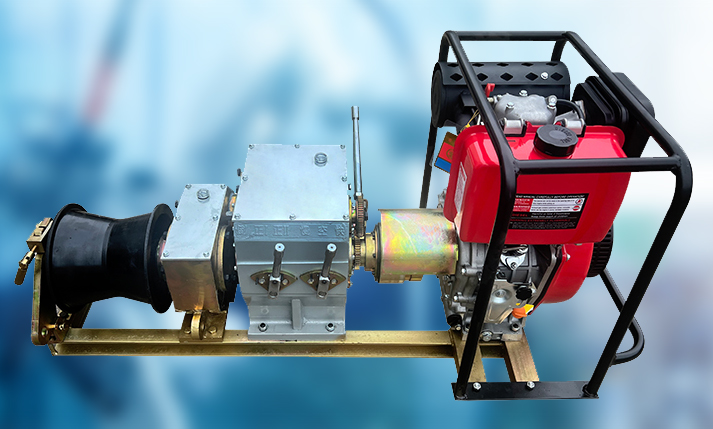
Many construction teams fall into a common misconception when choosing an 8-ton traction winch: focusing only on the tonnage and ignoring the actual output. In actual construction, some machines rated at 8 tons become sluggish after just a bend, while others break down completely during continuous operation in mountainous areas. Choosing the right model requires considering three key dimensions:
First, does the gear design match the actual working conditions? 8 tons of traction force refers to the peak output in the slow gear, but the real test of a machine is its efficiency in the fast gear. An excellent model should provide over 80kN of pulling force in the slow gear to handle obstacles, while maintaining a reel-in speed of over 10m/min in the fast gear, balancing extrication and efficiency.
Second, the logic behind power source selection. Diesel engines offer strong low-end torque and economical fuel consumption, suitable for continuous heavy-load scenarios in mountainous areas and the field; gasoline engines are lightweight and start quickly, suitable for short-distance, frequent site changes in urban areas.
Third, the emergency braking response mechanism. In high-altitude or underground operations, the ability of the braking system to lock the drum within milliseconds in the event of an accidental slippage is a critical safety concern.
In real-world testing, Xiangjian 8 motorized winch offers a dual solution. Its 80KN slow mode easily handles blockages caused by large-section cables passing through conduits; both models utilize shaft drive design, which is more efficient and slip-resistant than belt drives, and combined with a multi-disc brake, provides zero-delay braking response. It truly achieves “unfatiguing under heavy loads and smooth, responsive braking during emergency stops.” Choosing the right model, choosing KAP, provides double insurance for your engineering projects.