




Introduction
In modern power engineering and communication infrastructure projects, long-distance cable installation has become increasingly challenging. When cable laying distances reach hundreds or even thousands of meters inside tunnels, pipelines, underground ducts, or utility corridors, manual cable pulling alone is no longer practical.
To solve this problem, professional cable conveyor and cable pusher systems have become essential equipment for modern cable installation projects.
By organizing multiple cable conveyors into a synchronized transportation system, contractors can significantly improve installation efficiency, reduce cable damage, and ensure safe cable laying operations in complex environments.
—
Challenges of Long-Distance Cable Installation
In both power transmission projects and communication engineering projects, cable installation often involves:
* Long underground tunnels
* Utility pipelines
* Cable trenches
* Underground ducts
* Vertical shafts
* Curved cable routes
As cable length and cable weight increase, traditional manual pulling methods create serious problems:
* Excessive cable tension
* Cable insulation damage
* High labor costs
* Slow installation speed
* Cable deformation risks
* Difficult operation in confined spaces
For HV power cables and fiber optic communication cables, improper installation can result in expensive damage and long-term operational risks.
Therefore, professional cable conveyor systems are now widely used in modern infrastructure construction.
—
Why Multiple Cable Conveyors Are Necessary
For long-distance cable laying projects, a single cable conveyor machine is usually not enough.
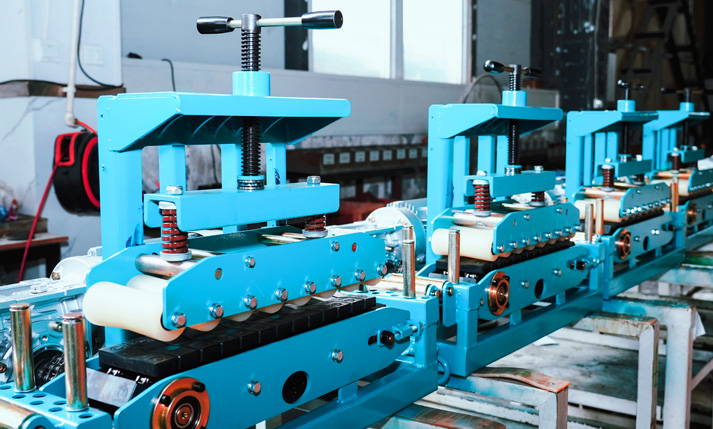
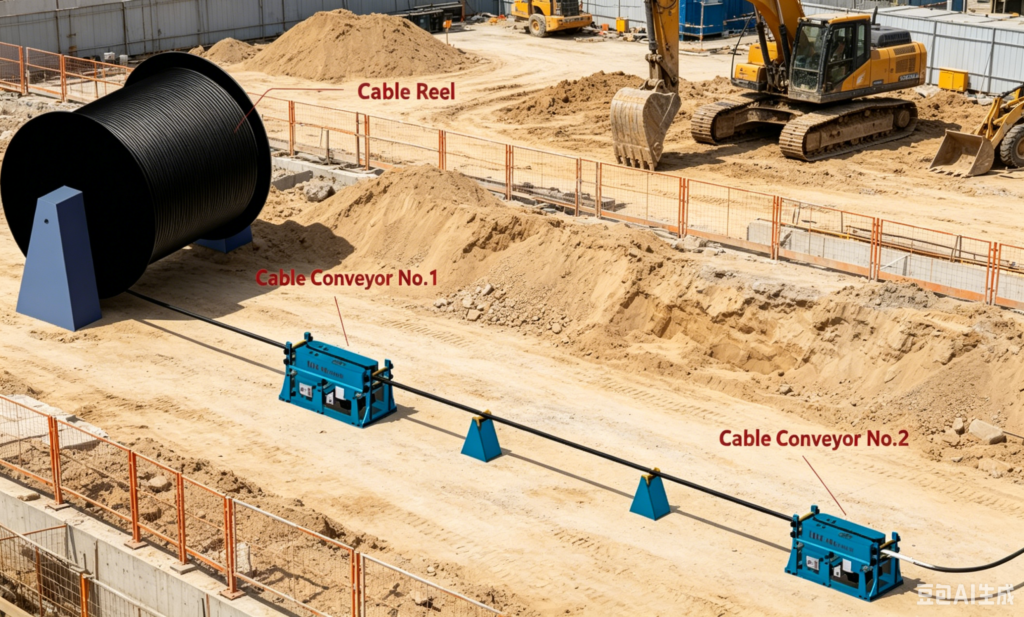
Professional engineering contractors often use multiple cable conveyors connected together to create a continuous cable transportation system.
This solution provides stable cable movement across long distances while reducing stress on the cable itself.
Cable pusher systems can help maintain continuous traction force and minimize friction during installation.
—
Key Principles for Cable Conveyor Layout
1. Proper Conveyor Spacing
The layout spacing of cable conveyors is one of the most important factors in successful cable installation.
The spacing between each cable conveyor depends on several factors:
* Cable weight
* Cable diameter
* Cable type
* Route bending angle
* Installation environment
* Vertical climbing sections
In straight cable routes, cable conveyors are typically installed every 15 to 30 meters.
However, in turning sections, curved tunnels, or vertical climbing areas, additional cable conveyors should be added to provide stronger support and maintain stable cable movement.
Reasonable conveyor spacing helps:
* Prevent excessive cable sagging
* Reduce cable tension
* Protect cable insulation
* Improve cable laying efficiency
—
2. Synchronized Operation and Centralized Control
When multiple cable conveyors operate together, synchronized control becomes extremely important.
All cable conveyor machines should maintain consistent:
* Starting speed
* Running speed
* Stopping timing
* Pulling force
A centralized control system allows multiple cable pusher machines to operate simultaneously and maintain stable cable transportation.
Modern cable conveyor manufacturers now provide multi-machine linkage control systems that allow all cable conveyors to work together as one coordinated system.
This helps prevent:
* Cable compression
* Cable stretching
* Cable dropping accidents
* Uneven pulling force
* Installation instability
Synchronized cable conveyor operation is especially important for long-distance underground cable installation projects.
—
3. Accurate Alignment and Smooth Transition
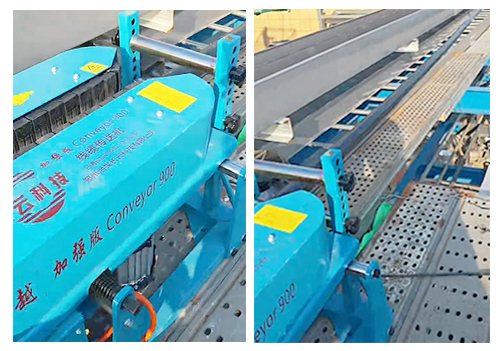
During installation, the roller center lines of all cable conveyors must remain aligned with the cable laying center line.
Proper alignment ensures the cable moves forward smoothly in a straight direction.
At the same time, adjacent cable conveyors should create a smooth transition between machines to form a continuous support surface.
This prevents:
* Sharp cable bending
* Surface abrasion
* Cable wear
* Uneven cable stress
Accurate alignment is particularly critical for high-voltage power cables and large-diameter communication cables.
—
Cable Conveyor Applications in Modern Infrastructure Projects
Cable conveyor and cable pusher systems are widely used in:
* HVDC transmission projects
* Power station construction
* Underground power cable installation
* Communication cable laying
* Fiber optic cable installation
* Utility tunnel engineering
* Substation projects
* Renewable energy infrastructure
* Railway power systems
* Urban underground cable projects
As global infrastructure development continues to expand, demand for professional cable conveyor equipment is increasing rapidly.
—
Advantages of Professional Cable Conveyor